
Medical Steel Doors vs Standard Steel Doors
Key Differences in Hospital Construction and Engineering Selection
Many buyers ask the same question when they first encounter hospital door systems:
“A steel door is just a steel door, right? Why are medical steel doors more expensive?”
This is a common misunderstanding.
From an engineering perspective, a medical steel door is not a decorative door.
It is part of a hospital functional infrastructure system, designed to meet strict requirements for hygiene, durability, safety, and infection control.
This article explains the core differences between medical steel doors and standard steel doors, based on five critical engineering factors.
1. Structural Design Differences
Standard Steel Doors
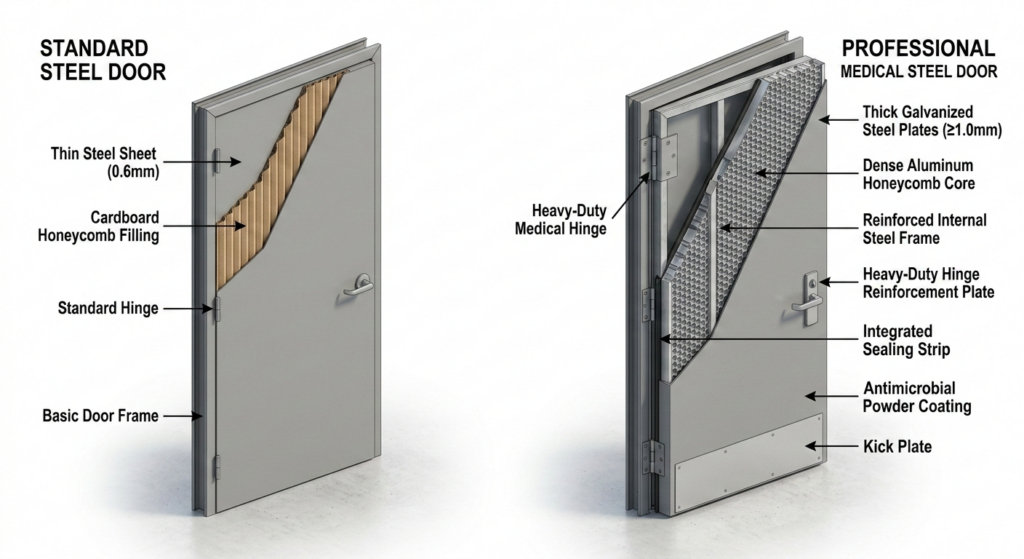
Standard steel doors typically use a simple construction:
-
Single-layer steel sheet structure
-
Basic internal filling materials
-
Standard door frames
-
No structural reinforcement
They are mainly used in:
-
Residential buildings
-
Offices
-
Shops and commercial spaces
Medical Steel Doors
Medical doors are designed for high-frequency use and healthcare safety standards.
Typical features include:
-
Double-sided galvanized steel sheets (≥0.8 mm)
-
Internal honeycomb or rock wool core
-
Reinforced door frame (≥1.2 mm steel)
-
Optional fire-rated or radiation shielding structure
In hospitals, doors may open hundreds of times per day, so structural reinforcement directly affects service life.
Structure determines durability.
2. Surface Treatment and Hygiene Requirements
Standard Steel Doors
-
Conventional paint coating
-
Easily scratched
-
Poor resistance to strong disinfectants
These finishes are designed mainly for aesthetic use rather than hygiene.
Medical Steel Doors
Hospital doors require surfaces that can withstand constant cleaning.
Medical doors usually feature:
-
Electrostatic powder coating
-
Optional antibacterial coating technology
-
Resistance to alcohol, chlorine, and hospital disinfectants
In healthcare environments where doors are disinfected multiple times daily, ordinary steel doors may show severe aging within 3–5 years.
3. Sealing and Cleanroom Performance
Standard Steel Doors
Typical characteristics:
-
No sealing structure
-
No air pressure control capability
-
Large gaps between door and frame
This is acceptable for residential or office buildings.
Medical Steel Doors
Hospital environments often require strict air cleanliness and pressure control.
Medical doors can include:
-
Airtight door structures
-
Embedded EPDM sealing strips
-
Automatic drop-down sealing systems
In critical areas such as:
-
Operating rooms
-
ICUs
-
Clean corridors
Door sealing performance directly affects air cleanliness levels and infection control.
This is not a comfort issue — it is a patient safety issue.
4. Fire Protection and Radiation Shielding
Standard Steel Doors
Most ordinary steel doors:
-
Have no fire rating certification
-
Provide no radiation protection
They are unsuitable for regulated medical environments.
Medical Steel Doors
Medical door systems can be engineered with additional protection features:
-
30-minute or 60-minute fire-rated construction
-
Integrated lead sheets (1–3 mm Pb equivalent)
-
Optional lead glass vision panels
These features are essential in areas such as:
-
Radiology departments
-
CT rooms
-
X-ray imaging rooms
-
Dental imaging rooms
Without proper shielding, a door cannot pass hospital construction inspection standards.
5. Hardware System Differences
Hardware on Standard Steel Doors
-
Light-duty hinges
-
Standard commercial locks
-
Basic closing systems
These components are designed for moderate usage.
Hardware on Medical Steel Doors
Hospital doors require heavy-duty hardware systems:
-
Reinforced load-bearing hinges
-
Medical-grade locking systems
-
Optional automatic door operators
Hospital doors may operate thousands of cycles per week, making hardware durability critical.
High-frequency use is the largest source of structural fatigue in door systems.
6. Service Life Comparison
Typical lifespan comparison:
Standard Steel Doors
-
Average service life: 5–8 years
Medical Steel Doors
-
Engineering lifespan: 10+ years with proper maintenance
Healthcare construction projects prioritize long-term reliability and compliance.
7. Why Medical Steel Doors Cost More
The higher price of hospital steel doors is mainly due to:
-
Thicker steel materials
-
Reinforced structural design
-
Antibacterial surface treatment
-
Advanced sealing systems
-
Optional fire-rated or radiation shielding structures
In essence, a medical steel door functions more like specialized medical infrastructure, rather than a standard building material.
8. When Can Standard Steel Doors Be Used in Hospitals?
In some hospital areas, standard steel doors may still be acceptable, such as:
-
Administrative offices
-
Non-clean corridors
-
Low-traffic service areas
However, medical steel doors are mandatory in critical zones including:
-
Operating rooms
-
ICUs
-
Radiology departments
-
Laboratories
-
Cleanroom corridors
Engineering door selection must always follow functional zoning requirements.
Conclusion
The difference between medical steel doors and standard steel doors is not simply material thickness.
It is a completely different design philosophy.
-
One is a decorative building door.
-
The other is a functional component of a healthcare facility system.
When selecting doors for hospital projects, the real priorities should be:
-
Long-term durability
-
Safety compliance
-
Regulatory approval standards
These factors are essential for successful healthcare construction projects.


